Jan 16, 2017

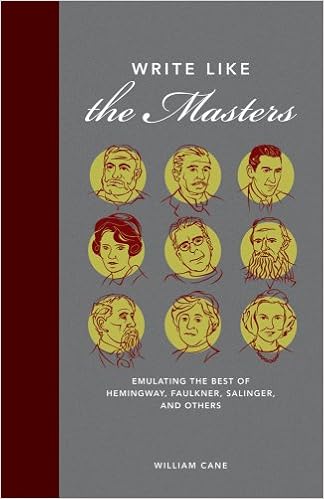
Writing Book: Write Like the Masters: Emulating the Best of Hemingway, Faulkner, Salinger, and Others by William Cane

Image from amazon.com

I saw this book on K. M. Weiland's site and thought it looked interesting. If you go by the cover, it looks kind of dry, but the definition of 'masters' is fortunately not only limited to the literary greats, but also includes genre writers like Stephen King and Ray Bradbury. 

As a writer, you don't actually want to copy someone else's style of course, but the idea presented by Cane is that much can be learned by imitation; that's how most of the big names of the 19th and 20th century got started, after all. The book is very readable, the chapters short, and I liked the bits of personal history in the text offering clues as to where these writers found their inspiration. I agree with Cane that understanding where a writer came from and what life experiences he or she is drawing from can lead to a deeper understanding of their work. 

Many of the writers discussed were already familiar to me, which was a plus as it helped me get the most out of the insights Cane offered about their writing process, but there were a few I had never heard of, like Knut Hamsun and W. Somerset Maugham. Based on Cane's analysis, I'm curious enough to try a book from each. 

Write like the Masters doesn't contain any writing exercises, which might have been a nice addition to the book, but I felt I got my money's worth. Cane points out the value of reading even those books that you don't like, because you can still learn from them. Apparently Edith Wharton thought James Joyce's work was self-centered, narcissistic, and sensationalist (yeah, I hear you!) but still learned to employ the use of epiphanies in her writing from him.  So disregard what doesn't work for you and pick and choose what does. I guess I should continue trudging through that list of classics. Sigh. 

If you're curious as to the complete list of writers included, you can examine the table of contents of the Kindle version on Amazon. 


Jan 13, 2017

Twinkle, Twinkle


The Minna Parikka webshop is having its annual January sale, and I just had to have these Stardust sneakers. I originally wanted the turquoise Ziggy boots, but I think I'll get more mileage out of these. 


Ooh, shiny!


These are as gloriously glittery as they look. They're very OTT, but at the same time the silver-and-black colour scheme tones them down enough that I'll actually wear them. I am curious as to how long the glitter will last when subjected to daily use. Anybody out there own glitter shoes? Any tips on how to care for these?


Jan 11, 2017

5 World-building Issues That Ruined Final Fantasy XV For Me

I've been a fan of the Final Fantasy series for years and played most of the games (I gave up on the abysmally boring FFXIII though), my favourites multiple times. FFXV is deeply flawed; I could talk about the nonsensical bachelors-on-a-roadtrip plot or the flat main characters, but the thing that ruins the game for me is the sloppy world-building. Ten years, and this is what they came up with? Really? REALLY?

So here's my list. This, dear writer pals, is an example of what NOT to do.

1) Good world-building gives your fantasy world a sense of believability, of cohesion. If you decide to set your game in a '50s Americana environment, you have to go all the way. You just can't have the gas stations selling potions, phoenix downs, and elixirs and the people wearing armour and using swords and other medieval weapons. In my opinion, the real world doesn't belong in Final Fantasy. It's a fantasy world, that's part of the charm. This kind of thing seriously strains the player's suspension of disbelief.

2) Product placement. You can't convince me that a Vivienne Westwood wedding dress belongs in a Final Fantasy game environment where people are hunting monsters and riding chocobos. You just can't.

3) The stereotypical and unfunny dialogue. The minor characters speak in an exaggerated southern accent and in 90 percent clichés. It's bordering on offensive. If writing a setting which comes with a specific dialect, do your research and find a beta reader who can help you with the dialect/slang.

4) Know your target audience. Fans of Final Fantasy have been pretty happy with the steampunk/medieval aesthetic. Sometimes a departure from the familiar is needed, but if the result is something so different that it's no longer recognisable as part of the franchise, you should probably rethink what you're doing.

5) Welcome to 2017. I know the game has been in the works for ten years, but the world has changed since then. The previous FF games certainly don't lack pretty girls in skimpy clothing, but usually the female characters have had some kind of agency and interesting backstories. You really cared about them. Now, for some reason, the developers decided to have four male main characters who are almost indistinguishable from each other ("likes to cook" isn't a defining character trait, guys, but more of a quirk.). The only women we are introduced to in the first hours of the game are Noctis' fiancé, who seems pretty passive, and Cindy the sexy mechanic, whose only real reason for existing seems to be flashing her cleavage at the boys while she gasses up the car and wipes the windshield. You need to do better.

So that's my list. What did you think of the game?


Jan 9, 2017

Market Research: Where to Send Your Short Stories?


So, you've written a short story, sent it through your critique group a few times, and edited until you can edit no more. What now?  You think about it for a few weeks. Maybe this one actually doesn't suck? Should I try to send it out? After ten more typo-checks you finally gather up the courage and decide to go for it, but then you do some googling and realise how many magazines there actually are out there. It can feel a bit overwhelming.

Okay, first things first. Before you actually send the story out, you'd better make sure it's correctly formatted. Each magazine has its own preference, and they notice if you're not paying attention. Just make your life easier and do exactly what the instructions say, because you want to appear professional, right? Most English language magazines prefer Shunn's manuscript format.There is bit of variation in font preference, like Times New Roman instead of Courier, but that's pretty much it. You should check whether the magazine is U.K. based or American and run a spell check accordingly. There are also some differences in grammar and punctuation, like the preference for single quotes instead of doubles in British English. Usage is trickier, because that's something you just have to know. (Things like 'flat' vs. 'apartment'. Your beta readers can help you with this. If you're not writing in your native language, this is even more important. I recommend Critters if you're looking for a critique group.) You'll also need a cover letter, the simpler the better. Here are a few examples from Strange Horizons. And don't obsess about who to address it to, 'dear editor' is probably fine.

For my Finnish readers, the rules seem to be a bit more relaxed here. Finnish anthologies usually give you a page count instead of a word count, and the formatting is usually font size 12, 2 cm margins, and a line spacing of 1,5. That gives you about 30 lines of text per page.

Okay, now you need to find a magazine to submit to. If you want to start at the top, go for the SFWA qualifying markets. Those are the best of the best, the 'pro markets,' and if you make a sale you can apply for SFWA membership. And no, you don't have to live in the U.S. to qualify. On a semi-pro level there are other resources you can use, like Dark Markets, a website that lists new calls to anthologies and magazines and is free to use. See also ralan.com. Most people start with the semi-pros and work their way up to the pro markets. I like Duotrope, but it costs 50 USD per year. Nowadays the majority of magazines use electronic submissions, which makes things much easier for us foreigners.

You should try to read the publication before you submit to it to get a feel for what they want. There are so many markets that this feels impossible at times, but it helps to narrow down the markets that feel more 'you.' My favourite pro magazines are Shimmer, Apex, and Clarkesworld, so I try to follow those at least. I got a subscription to Apex and Clarkesworld, but the Shimmer subscription system was a bit weird (it looked like you'd need to buy every issue separately), so I got the collected short stories for 2014 and 2015 from Amazon. I like to support the magazines by subscribing, but if you don't have the cash you can read most of the content on their websites.

To keep track of your submissions and sales, you need to log them into some kind of spreadsheet, but one reason I like Duotrope is that it does this for me, so I can always check where the piece has been so I don't accidentally resubmit to the same market. It also has statistical info on response times, acceptance rates, etc, so you can obsess over follow what's going on with your piece.  The Grinder is a similar but free service, but I've found Duotrope to be worth its price. It seems to have more users and it also suggests similar markets to submit to, so it's easier to find the next place to submit after a rejection.

For Finnish spec fic writers, Shimo Suntila wrote a piece about the Finnish markets and competitions recently. Check it out here. In Finland it's rare to get paid for speculative short stories, mostly the 'payment' is getting published. The competitions have cash prices, though.

Before you get started, I have a few pieces of advice: don't take rejection personally (yes, you will get rejected. Multiple times.), resubmit the piece to a different market the next day after a rejection and get on with writing the next one, and don't self-reject (the editor might surprise you). Here's what Chuck Wendig has to say about rejection. Read it. It always makes me feel better after I get one.

Okay, that's it. Happy submitting!


Jan 6, 2017

The Gates of Moria Mittens


Look what I got for Christmas! My crafty friend has outdone herself yet again. The colour isn't coming off right it the pics, it's more of a purplish-blue kind of thing, but you can see the detail here.


Here's a look at the other side. They've even got the text "speak, friend, and enter" on them!


Jan 4, 2017

Terra Incognita


Reading non-fiction books is a great way to find story ideas, and Atlas Obscura by Joshua Foer, Dylan Thuras, and Ella Morton is a treasure trove of fascinating facts and places. Although you can visit many of the sites listed, this isn't a guidebook, not really; it's more like a collection of curiosities. Many of the descriptions are quite short, so if you get inspired you'll probably need to do more research, but on the other hand longer descriptions might tire you out while reading the book. 


Here are a few pages from the book. Some of my favourites included learning about a device that uses leeches to predict the weather, strange delicacies like the eggs boiled in the urine of young boys, and monks who try to embalm themselves. 


I also picked up these. You can never have too many atlases, right?


Jan 1, 2017

The Old Year and the New


2016 is gone, welcome to 2017, everyone! The world is kind of scary right now, and about to get scarier after Trump steps into office. And it's not just the US: the same political climate is palpable in Europe, and there are lots of important elections coming up this year, most notably the French presidential election and the German parliamentary election. (Read more here, for example.) Let's hope it all turns out better than expected.

Moving on to happier things, on the writing front 2016 was a busy year for me. I published some drabbles, but no short stories. That doesn't mean I wasn't writing. I did write five or six stories in English and about the same in Finnish. Two of the Finnish stories won awards ("Kylmempi kuin jää"/ honourable mention in the Portti competition and "Vedenneito"/2nd place in the Nova competition). Another story "Kun nokkoset kukkivat" was accepted to the Finnish anthology of Gothic stories. I also submitted stories to the Genreblender competition and Lumen ja jään antologia, both in Finnish., and some drabbles and a story to the English edition of Cosmos Pen, the magazine my writers' association publishes.

I didn't submit that many English pieces in 2016, but I've got about three making the rounds right now, one of which is currently being held for further consideration. I also took part in the Apex flash fiction competition. There are about three more stories that I should finish editing so I could send them out. I also participated in two online writing courses from the University of Iowa, so those cut into my writing time a bit but were extremely valuable, craft-wise. There's a story opening I did for the class that I'd like to develop further, hopefully soonish so I'll have something to submit to Critters.

Even though I didn't publish much, I feel that something has changed about my writing. I've started getting personal rejections from the pro mags, which is a good sign, and the placing-in-competitions thing is also encouraging. I guess I'm levelling up, as Cat Rambo put it.  Mind you, I'm nowhere near to where I want to be. I'm Bambi, just learning to stand up on the ice, while my favourite authors are the ones gliding by, doing triple axels while juggling seven flaming daggers at the same time. Lots of work ahead, but it's nice to see that I'm making some progress.

What about 2017? Well, my goal is still the same: to write something good enough to be published in a pro mag. My favourites of the SFWA eligible markets are Shimmer, Apex, and Clarkesworld, so I decided to start reading them regularly to get a better feel for what the editors are looking for, and hey, reading more great short stories? That's a win-win, anyway you look at it. I'm also planning to get a subscription to Portti, the major Finnish science fiction magazine. I'm still carrying on with my critique groups this year, of course, and I'll probably participate in the 2017 How Writers Write Fiction course, too.

And 2017 can't be all bad; Worldcon will be in Helsinki this year, that's exciting! I'm also looking forwards to playing the new Mass Effect and Persona games and seeing the new Guardians of the Galaxy movie.

So, happy New Year. Hopefully the world will be a little bit brighter in an year's time.