Showing posts with label writing books. Show all posts

Jan 16, 2017

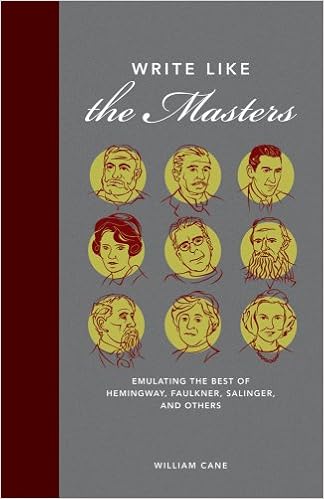
Writing Book: Write Like the Masters: Emulating the Best of Hemingway, Faulkner, Salinger, and Others by William Cane

Image from amazon.com

I saw this book on K. M. Weiland's site and thought it looked interesting. If you go by the cover, it looks kind of dry, but the definition of 'masters' is fortunately not only limited to the literary greats, but also includes genre writers like Stephen King and Ray Bradbury. 

As a writer, you don't actually want to copy someone else's style of course, but the idea presented by Cane is that much can be learned by imitation; that's how most of the big names of the 19th and 20th century got started, after all. The book is very readable, the chapters short, and I liked the bits of personal history in the text offering clues as to where these writers found their inspiration. I agree with Cane that understanding where a writer came from and what life experiences he or she is drawing from can lead to a deeper understanding of their work. 

Many of the writers discussed were already familiar to me, which was a plus as it helped me get the most out of the insights Cane offered about their writing process, but there were a few I had never heard of, like Knut Hamsun and W. Somerset Maugham. Based on Cane's analysis, I'm curious enough to try a book from each. 

Write like the Masters doesn't contain any writing exercises, which might have been a nice addition to the book, but I felt I got my money's worth. Cane points out the value of reading even those books that you don't like, because you can still learn from them. Apparently Edith Wharton thought James Joyce's work was self-centered, narcissistic, and sensationalist (yeah, I hear you!) but still learned to employ the use of epiphanies in her writing from him.  So disregard what doesn't work for you and pick and choose what does. I guess I should continue trudging through that list of classics. Sigh. 

If you're curious as to the complete list of writers included, you can examine the table of contents of the Kindle version on Amazon. 


Oct 10, 2016

Writing Book: Writing the Other by Nisi Shawl and Cynthia Ward


I found this book via Chuck Wendig's blog, this post to be exact. Elsa S. Henry wrote a guest post about writing blind characters and then about a masterclass she was doing in collaboration with the Writing the Other website. I wanted to participate in the course, so I checked out the site. The timing didn't work out, but I did find a lot of interesting material on the site about writing characters different from you. Writing the Other is a book Shawl and Ward wrote to use as material for the courses. It's available on Amazon as an e-book and paperback.

The book got started when a writer at the Clarion 1992 workshop voiced an opinion that you shouldn't even try to write characters outside your own ethnic background, because you'd probably get it wrong and offend people. Better stick to your own experiences.

I do get this, because as a white straight woman I have these fears too. I don't actually know any POC,  how could I understand their experience well enough to write from their point of view? And even if I did all the research I could and talked to people (Scary, because I'm still a shy, socially awkward person who doesn't make friends easily), would I be stepping on toes writing about issues that don't affect me directly? And from a place of white privilege, no less?  Would it be better to leave these issues to the people who have actually experienced them and celebrate books by POC writing about their own experience? And it's not just about ethnicity. The same thing applies to writing characters whose sexual orientation or religion differs from your own and writing about disabled characters when you yourself are able-bodied. Shouldn't you just write what you know? That's like the first thing they teach you in every writing book.

I grew up in a predominately white neighbourhood. In Finland there weren't any people of colour in my class or even in the whole school that I remember. For the two years we lived in California there were, but I was just eight at the time, so I don't remember that much about my time there. I was in the ESL (English as a second language) class most of that time, because I didn't speak any English when we moved to the States. As a shy person I didn't make many friends and I didn't keep in touch with anybody after we moved back to Finland. I do know some people online through my writing workshop, but that's pretty much it.

On the other hand, isn't writing characters different from you the whole point of writing in the first place? Understanding someone else's experience? In speculative fiction you can cheat a bit by writing about aliens or fantastical creatures, but I do think it's kind of limited to just write about straight white people all the time.  Shawl and Ward also take this view and encourage writers to step out of their comfort zone.

The book discusses ROAARS (Race/Orientation/Ability/Age/Religion/Sex) traits and how they affect characterisation. There's also a chapter on writer hang-ups about writing outside their experience, talking about fear of the other and the liberal dread of the racist label, which can lead to ignoring any differences you notice between different groups out of political correctness and fear.                                      

Shawl and Ward begin with discussing the "unmarked state" that readers assume unless otherwise informed: male, white, heterosexual, able-bodied, young. Then they move to the concept of privilege. If you match most of the attributes stated above, you won't experience the abuse that people who differ in some aspect do. They also use the term parallax to illustrate how the viewpoint shifts when your character is different from the unmarked state and talk about the dangers of categorical thinking (i.e. mistaking traits of an individual for traits of a group), and unintended and intended associations and resonances. There's also the concept of congruence, how similarities between the writer and character and reader and character help to understand the character and how the use of non-ROAARS characteristics can generate reader sympathy.

There's also a chapter about things you shouldn't do, like avoiding stereotypes, making the POC/LBGTQ/disabled character a sidekick without any goals of his/her own, portraying them as victims all the time, and using a disrespectful dialect, for example. Best of all, there are exercises, specific references, and reading lists to help you along.

The Writing the Other website is full of useful stuff, too. You can sign up for the masterclasses (Definitely will do one of those at some point. I just have to figure out the time difference etc.), peruse the material available for free on the site, watch videos, and there's also info on how you can get in touch with sensitivity readers, really useful for connecting with people for scaredy cats like me. They emphasise that a sensitivity reader should get paid, which is reasonable, of course.
writeinthemargins.org has a database of sensitive readers, for example.

A very useful book that every writer should read.


Aug 8, 2016

Writing Book: Deep Point of View by Rayne Hall


I'd been trying to improve my character development skills for a while and wondering why it's sometimes so hard to get up close and personal with my protag, when I came across the concept of deep point of view. Basically it's the same thing all the books on description try to teach you: show, don't tell.

What deep point of view comes down to is cutting any distancing words and just stating what the protagonist feels, thinks, and experiences. Mostly the culprits are words like "felt," "thought," "wondered," and sense words like "saw," "smelled, and "tasted." Using active verbs and avoiding author intrusions is also a part of this. The idea is to make it feel like the reader is living the story, not reading it. Writing deep point of view requires changing the way you think and write: you have to become the character, separate your own attitudes and reactions from the character's, almost like you're acting. At first it's hard, but when you've been doing it long enough, it becomes second nature.

The book says that it's not for beginners, but I found it easy enough to follow. It's a fast read with clear examples and useful exercises, so no technical stuff, if that scares you. Hall discusses using different points of view,  picking the right POV character and avoiding head-hopping, filtering observations through the character's experiences and interests, giving the full sensory experience, the difference between male and female POV, using situation and mood as filters, writing character thoughts and emotions, the importance of keeping trigger and response in the right order, using similes for expressing backstory, how to describe your protagonist's appearance in deep POV, and the importance of body language. We also get a few sample stories. If you've read a few writing books, you probably know most of this already, but it's useful to have it all collected in one volume.

I found this book useful, but if all the things I listed in the last paragraph seem like kiddie stuff to you, might be that you're already writing deep point of view without knowing it. If you're a newbie like me, you might want to check it out. And it's worth noting that this book is part of a series. You can explore the other volumes on the writer's website.


Feb 1, 2016

Writing Book: The Fantasy Fiction Formula by Deborah Chester


The Fantasy Fiction Formula is a great writing book by Jim Butcher's mentor. I love Butcher's Dresden Files series, and when I saw the book mentioned on his site, I had to get it, and I wasn't disappointed.

This book is geared towards genre writers, and you get what is says on the cover: well-written, practical advice. The examples have to do with wizards and werewolves, and Chester's style is fun and entertaining. If you've read a lot of writing books, most of the information is familiar, but Chester's approach is very useful, with examples that help illustrate the point she's trying to make. The great thing is, you get examples of both the wrong way and the right way, which makes it easier to spot your own mistakes.

I found the book useful and learned a few new tricks, but the best thing for me was that it describes the process of writing a story or novel from start to finish, and it helped me fuse all the information floating around my brain into one concise whole. If you've already written a book or two, you probably don't need this, but for beginners trying to write speculative fiction this is worth every penny.

The first thing I'm going to try is the SPOOC method for testing story premises. The acronym comes from Situation, Protagonist, Objective, Opponent, Climax. When you combine them, you'll get a two-sentence plot summary. So Harry Potter and the Philosopher's Stone might look  something like this:

Situation: When he finds out that someone is after the Philosopher's stone hidden in Hogwarts School of Witchcraft and Wizardry
Protagonist: Harry Potter
Objective: vows to keep it safe.
But can he stop
Opponent: the evil Lord Voldemort
Climax: from stealing it and coming back?

The character-building and revision questions are also useful, and the story structure sections are easy to understand.

In conclusion: one of the best writing books I've read. Go ahead and get this if you're a genre writer. Into science fiction or horror? Don't let the fantasy bit scare you off; you'll still get plenty of use from this. Highly recommended.

(If you're a literary writer, you will probably hate this and feel like the book is trying to box you in. If the concept of plot makes you dry-heave, move along. This is not the writing book you're looking for.)


Dec 28, 2015

Writing Book: Word Painting by Rebecca McClanahan


Image from amazon.com
                                        

I've read a lot of writing books. The good ones give you solid advice and pointers, but the great ones open up concepts that you thought you understood and give you a new viewpoint into the subject at hand. 

Word Painting is one of the great ones.

Any time you read a writing book, they talk a whole lot about finding your voice, but I think that by voice they mean your own way of doing description. For me, learning about description was a major turning point in my writing. The Elements of Fiction Writing series books Description and Setting  helped me understand the basics, to start thinking about the world differently. Metaphors and similes started to come to me as I walked to work or waited in line at the grocery store. I started noticing the little things, the telling details about people, their habits and quirks. I also stopped walking through the world with blinders on, only focused on getting where I was going, mind full of work woes or shopping lists. There’s a lot to see if you just slow down and really look. Ask any three-year-old.

 Word Painting covers the basics and a whole lot more. There’s a chapter on using all the senses, on setting, on character descriptions, point of view, and plot. I especially liked the chapter on the big picture, an attempt to pin down that elusive thing called theme and explain how your description can help bring it forth. Every chapter also has a number of useful and fun exercises at the end of it.     

Here are a few things I learned:

Good description should be carefully worded, specific and accurate, but also take into account the musical quality of language. It should be sensory, concrete rather than abstract, and in motion when possible. Figurative language is important. Description should be appropriate for the story you’re writing: flowery prose can ruin a story that calls for simple clarity.

Language is musical; harsh consonants give a different feel than liquid vowels. Word choice matters; even if a word is accurate, is it significant, appropriate, musical? Does it fit the story? Is your language active or passive, cluttered or direct?

Observation is important. You have to notice the little things, to be accurate. But you must also use the eye of imagination to bring your descriptions to life. The eye of memory is useful, as is insight and the eye of dreams. You mustn’t judge the object of your gaze, but be accepting. Finding beauty in the grotesque or flaws in perfection can yield effective and unique imagery. Things in motion are more interesting than something standing still. Try to regain the child’s eye of looking at the world, that seriousness of play.

Sometimes it’s more powerful to describe what you don’t see/hear/feel than what you do. (McClanahan calls this the back-door technique.)

Remove the filtering devices: you don’t need to use words like “feel,” “see,” “notice,” or "taste." You can just state image directly.

Synesthesia (the phenomenon in stimulation of a sensory pathway evokes sensation in another) is good.  (You know, something like: The apple tasted of midnight walks under the harvest moon, of first loves lost, of autumn’s cinnamon kisses, and the bitter bite of frost.)

I learned a new term: implied metaphor. It means just what it says: the metaphor is implied rather than stated outright.  For example, you can say “her eyes are like dark forest pools,” or you can imply it: “you could drown in the loamy darkness of her eyes.”

Extending your metaphors is a good idea.

Don’t go totally bonkers with your metaphors though, there’s original and then there’s just plain confusing.

You can use your setting to describe a character, or their inner landscape. (The chapter on describing characters is gold.)

  McClanahan teaches at Queens University and the Rainier Writers workshop, but she also does workshops all over the US, so if you're lucky enough to have a chance to participate in one, go for it. (I'll be right here, waiting for an online course. No, not jealous at all, Okay, I'm lying.) 

Here's a link to Amazon if you want to get the book.
 

Dec 3, 2015

Writing Book: Ron Carlson Writes a Story


Ron Carlson Writes a Story is just that: a book about how Ron Carlson writing a short story. It's a short book, just 112 pages, and that's including the short story in question, "The Governor's Ball."

I picked up the book because a lecturer in the How Writers Write Fiction course recommended it. I'm always looking for pointers on short story writing, so I was exited to find a whole book devoted to the short story.  It's very interesting to see someone else's writing process so meticulously explained, and I think it had a nice bit of writing advice sprinkled in between the lines, like how to avoid cliches and surprise the reader, being specific with your description etc. Main point that stuck: Do not give in to distraction. Finish your story, whatever it takes. Just say no to the lure of coffee, the internet, and the outside world.

That said, this is very much a literary writer's book. The process is the pantser process, i.e. starting with an idea or a scene and then just going for it, sentence by sentence. There are snide comments about genre writers, but if you can cope with that, then by all means go for it and read the book.

I did recognise some of the stages Carlson went through, like the part where you really, really just want to quit because you don't know what's going to happen next and it's all too overwhelming and hard. That's why I like to do a bit of planning before I start. I need to have some rough idea of an ending, something to aim for. I think it helps take the pressure off. I don't necessarily have to end up where I planned, and if the story wants to take a detour, by all means, I'm game, but that doesn't change the fact that without a goal I'll just get lost in the story woods and eventually get tired of writing in circles and give up.

This is just one writer's process. We're all different; what works for him might not work for the rest of us.

An interesting read, all the same.